Differentially Private Training in the LLM Era Di Wang, Assistant Professor, Computer Science Sep 28, 12:00 - 13:00 B9 R2325 privacy-preserving AI LLM LLM training systems stochastic gradient descent optimization This seminar explores how to make differentially private training practical and scalable for large language models and new methods that enable stronger privacy guarantees without sacrificing performance.
The Broximal Point Method and Its Impact on Optimization Theory and Machine Learning Peter Richtarik, Professor, Computer Science Sep 21, 12:00 - 13:00 B9 R2325 Broximal Point Method proximal algorithms machine learning gradient methods This talk introduces the Broximal Point Method (BPM), a condition-number-free alternative to classical proximal methods, that replaces proximal penalties with ball constraints, surveys its theoretical extensions and distributed variants, and explains how approximate non-Euclidean Brox updates underpin practical machine learning optimizers.
NVIDIA Days at KAUST Sep 15, 20:45 - Sep 17, 17:00 B2/3 A0215 HPC NVIDIA agentic AI systems Physical AI digital twins robotics weather GPU quantum computing Join us (registration required) for the KAUST Supercomputing Lab (KSL) NVIDIA Days from September 15 to 17, 2026, a three-day program supporting the community's ongoing work in AI and High Performance Computing (HPC) through expert-led sessions, personalized clinics, and hands-on training.
SADIQ: An Intelligent Context-Aware IoT System Basem Shihada, Program Chair, Computer Science Sep 14, 12:00 - 13:00 B9 R2325 SDN Quality of service IoT software defined network This talk will identify the unique quality of service (QoS) needs of emerging IoT applications and propose SADIQ, which is a software-defined network (SDN) system that addresses these needs.
Algorithmically Faithful and System-Efficient Optimization for Large Language Models Liangyu Wang, Ph.D. Student, Computer Science Sep 8, 13:30 - 16:30 B4 R5209; Zoom Meeting 99767080624 LLM Neural Network training algorithms Optimization for Machine Learning LLM training systems The thesis develops an optimizer-aware systems view in which these methods are treated as structured computations with algorithmic invariants, memory behavior, communication objects, and scheduling constraints.
The Event Horizon Telescope: From the First Images to the First Movies of Black Holes Laurent Loinard, Professor of Astronomy, Institute for Radio Astronomy and Astrophysics (IRyA), National Autonomous University of Mexico (UNAM) Sep 7, 16:00 - 17:00 B20 Auditorium Astrophysics Visualization High Performance Computing algorithms telescope statistical inference computational analysis galaxy black holes astrometry This lecture explores the Event Horizon Telescope's groundbreaking achievements in imaging supermassive black holes, details the complex global and computational infrastructure enabling these discoveries, and outlines the future transition from static images to dynamic, real-time movies of the universe's most extreme environments.
The Dark Side of Metaverse: Unmasking the Threats from eXtended Reality (XR) Systems Tao Ni, Assistant Professor, Computer Science Sep 7, 12:00 - 13:00 B9 R2325 extended reality XR cyber-physical systems privacy cybersecurity This talk reveals how the seamless integration of computation, networking, and physical components in XR devices turns every layer of the system into an attack surface that non-intrusively leaks user privacy, ranging from what users type and do to what they perceive in virtual scenes.
Computer Science: Research, Innovation & AI at the Frontier Basem Shihada, Program Chair, Computer Science Aug 31, 12:00 - 13:00 B9 R2325 AI Cyber Security HPC Computational biology Computer Information Systems industry Computer science Higher Education KAUST's Computer Science department is a research-intensive graduate program covering AI, systems, security, HPC, and computational biology, with strong faculty, industry partnerships, and citation impact.
QCRG Special Seminar: Q.ANT – Photonic Computing for Real-World Applications Utz Bacher, Vice President Software, Q.ANT Aug 27, 16:00 - 17:00 B4/5 A0215; Zoom Meeting 92514602742 quantum computing photonic computing high performance computing emerging technologies The seminar presents Q.ANT's approach to photonic computing - a technology that offers a path to practical, product-ready solutions for real-world computational challenges, distinct from quantum computing.
Understanding Practical Optimization in Machine Learning Egor Shulgin, Ph.D. Student, Computer Science Jul 22, 17:00 - 19:00 B5 R5209; Zoom Meeting 95703397179 Optimization for Machine Learning AI artificial intelligence machine learning Optimization design and machine learning This dissertation studies how practical optimization methods used to train modern machine learning systems can be better understood by analyzing the objectives, updates, assumptions, and approximations that arise in their actual implementation.
Bridging the Gap: AI-Driven Software Quality Assurance Dr. Eman Abdullah AlOmar, Assistant Professor, Charles V. Schaefer Jr. School of Engineering and Science (SES), STEVENS Institute of Technology Jul 20, 11:00 - 12:00 B2/3 L0 R0215; Zoom Meeting 96002635189 AI Trustworthy AI LLM nlp AI agents Join Dr. Eman Abdullah AlOmar as she discusses how AI is reshaping software quality assurance and the challenges of building reliable and trustworthy AI systems.
Gray Scott School 2026 Jun 29 - Jul 2, All day B3 L2 R2202 HPC Performance optimization parallel computing Join an international training program focused on GPU computing and HPC technologies.
Differentiable Optics for Automated Optical Design and End-to-end Computational Imaging Xinge Yang, Ph.D. Student, Computer Science May 11, 17:00 - 18:30 B1 R2202 differentiable optics computational imaging optical design automated design augmented reality virtual reality AR VR This thesis develops a differentiable optics and image simulation framework, with applications in automated lenses and AR/VR design and end-to-end computational imaging with novel camera systems.
Multimodal Agents: From Automation toward Open-Ended Self-Improvement Mingchen Zhuge, Ph.D. Student, Computer Science May 9, 17:30 - 19:30 B4 R5220; Zoom Meeting 91489077683 AI agents coding Multi-agent systems world models recursive self-improvement LLM Deep Reinforcement Learning This thesis presents practical methodologies for building scalable multimodal agents that move from narrow automation toward open-ended self-improvement.
Learning under Limited Information across Federated, Multi-Agent, and LLM Settings Salma Kharrat, Ph.D. Student, Computer Science May 7, 15:00 - 16:45 B3 R5220 Federated learning personalized learning decentralized learning Reinforcement Learning black-box optimization prompt optimization decentralized systems combinatorial optimization observability inference Trustworthy AI trustworthy machine learning intelligent systems LLM This dissertation studies learning under structural information constraints across three major paradigms: federated learning, cooperative multi-agent reinforcement learning, and black-box optimization of large language models.
What Survives When Code Doesn’t? Dr. Laurent Bindschaedler, Research Group Leader, Max Planck Institute for Software Systems (MPI-SWS) May 4, 12:00 - 13:00 B9 R2325 Trustworthy AI trustworthy machine learning coding AI axplainable AI software development This talk explores how AI-driven code generation shifts the role of software from a durable artifact to a disposable implementation and argues for a new computational model for agentic software that formalizes the fundamental guarantees of intent, state, composition, and effect into explicit, enforceable contracts.
Causal Reasoning in Medical Digital Twins: Methods and Architectures Sakhaa Alsaedi, Ph.D. (former), Computer Science Apr 29, 03:00 - 05:00 B3 R5209 explainable AI reasoning causal representation learning medical digital twins personalized medicine AI AI for healthcare This dissertation develops a principled computational framework for causal reasoning in Medical digital twins (MDT) systems, moving beyond correlation-driven approaches toward explainable and biologically grounded decision support.
Publication Ethics and Authorship - Including the Responsible and Ethical Use of AI in Research Sidney Engelbrecht, Senior Research Compliance Specialist, Research Operations Apr 26, 12:00 - 13:00 B9 R2325 research ethics scientific research AI This talk outlines essential publication ethics and best practices at KAUST, focusing on authorship criteria, researcher responsibilities, dispute resolution, and the ethical use of AI in scholarly writing.
Introduction to Research Ethics and Integrity - Including Issues Around Research Misconduct Sidney Engelbrecht, Senior Research Compliance Specialist, Research Operations Apr 19, 12:00 - 13:00 B9 R2325 research ethics scientific research This talk outlines KAUST's research ethics governance, detailing the submission processes for Research Ethics Committees and the institutional procedures for reporting misconduct and grievances.
Private and Robust Learning for Decision Making Yulian Wu, Ph.D. Student, Computer Science Apr 14, 15:00 - 17:00 B4 R5220; Zoom Meeting 98132861421 decision making Trustworthy AI privacy-preserving AI Data Privacy machine learning artificial intelligence AI This thesis develops the theoretical foundations of decision-making under privacy, heavy-tailed feedback, and data contamination, establishing fundamental limits and designing near-optimal algorithms across bandits, reinforcement learning, and RLHF.
The Role of Humans in Scientific Discovery in the Age of LLMs — Beyond Asking: Turning LLMs into Research Collaborators Sir Bashir M. Al-Hashimi, Vice President, Research & Innovation, King’s College London (KCL); Distinguished Professor, Department of Engineering, Faculty of Natural, Mathematical & Engineering Sciences, King’s College London (KCL) Apr 8, 12:00 - 14:15 B9 R2325 AI artificial intelligence LLM scientific research scientific knowledge Assistive Technology Rather than offering definitive conclusions, this talk seeks to stimulate dialogue, question assumptions, and inspire new forms of collective thinking about the future of scientific research and doctoral training in an AI-driven world.
DePIN: From Decentralization Promise to Security Reality - A Critical Dissection of Trust, Privacy, and Architectural Illusions Roberto Di Pietro, Professor, Computer Science Apr 6, 12:00 - 13:00 B9 R2325 privacy preserving techniques cybersecurity Web and Network security DePIN Decentralized Physical Infrastructure Networks VPNs dVPNs computer networking decentralized infrastructure systems In this talk, we critically examine DePIN systems through the lens of two complementary studies. First, we provide a systematic analysis of the DePIN paradigm, identifying its core architectural pillars - blockchain, IoT, and tokenomics - and exposing fundamental vulnerabilities arising from operating in a zero-trust, open-participation environment.
Can AI Make Physicians Better at Diagnosis? Ihsan Ayyub Qazi, Full Professor, Computer Science, Lahore University of Management Sciences (LUMS) Mar 30, 12:00 - 13:00 B9 R2325 AI Trustworthy AI Diagnosis behavioral analysis decision making LLM Biomedical This talk presents a framework for understanding physician-AI collaboration in clinical decision-making, showing that while structured AI literacy training can significantly improve diagnostic accuracy, physicians remain vulnerable to automation bias when LLMs err, highlighting the need to carefully manage human trust and reasoning in AI-assisted clinical decision-making.
Demystifying Adversarial Patch Attacks and Defenses in the Physical World Tao Ni, Assistant Professor, Computer Science Mar 16, 12:00 - 13:00 B9 R2325 Trustworthy AI Computer Vision computational predictions spoofing In this talk, I will introduce a series of adversarial patch attacks in face recognition systems and autonomous driving cars, and present our recent studies in developing a zero-shot and patch-agnostic defense framework.
Provable and Measurable Machine Unlearning in Modern Learning Systems Cheng-Long Wang, Ph.D. Student, Computer Science Mar 10, 10:30 - 12:30 B2 L5 R5209 Machine Unlearning Data Privacy Trustworthy AI Federated learning machine learning AI This dissertation examines the foundations of machine unlearning under realistic learning system constraints and proposes both theoretically grounded unlearning algorithms and principled evaluation frameworks for modern learning systems.
Learning to Identify and Exploit Neural Network Dynamics in Multi-Step Inference Haozhe Liu, Ph.D. Student, Computer Science Mar 9, 13:30 - 15:30 B4 L5 R5220; Zoom Meeting 95866424218 This dissertation studies the temporal dynamics of multi-step inference and reveals that contributions across steps are sparse and uneven.
Extreme Computing Universals David Keyes, Professor, Applied Mathematics and Computational Science Mar 9, 12:00 - 13:00 B9 L2 R2325 HPC APIs extreme computing smart systems parallel computing software development This talk redefines "extreme" computing as operating under severe resource constraints rather than just massive scale, outlining universal algorithmic, hardware, and system-level strategies to overcome these challenges, illustrated by KAUST success stories.
Assessing Network Middlebox Impact on End-to-End Protocol Behavior via a Distributed and Reprogrammable Framework Ilies Benhabbour, Ph.D. Student, Computer Science Mar 4, 13:00 - 16:00 B5 L5 R5220 cybersecurity Cryptography distributed computing This dissertation focuses on the detection and verification of network middleboxes thanks to the creation of a new distributed framework called NoPASARAN.
From Prompts to Production: The Systems Agenda for Agentic AI Marco Canini, Professor, Computer Science Mar 2, 12:00 - 13:00 B9 L2 R2325 AI observability reproducibility Computer Information Systems In this talk, I will discuss our recent work on benchmarking, evaluation, and deployment of multi-agent LLM systems, and use it to outline a broader research agenda for agentic AI as a systems discipline - where progress depends not only on better models, but on principled infrastructure for observability, reproducibility, safe experimentation, and scalable execution.
Towards Scalable and Structured Understanding in Visual LLMs Mohamed Elhoseiny, Associate Professor, Computer Science Feb 23, 12:00 - 13:00 B9 L2 R2325 LLM Visual Language Models VLMs visual computing In this talk, we explore a suite of recent advances toward scalable, structured video comprehension using Large Vision Language Models (Video LLMs).
Eyes in the Sky: AI-Based Camel Identification and Tracking Using Drones Basem Shihada, Program Chair, Computer Science Feb 16, 12:00 - 13:00 B9 L2 R2325 AI drones animal tracking In this talk, I present a low-cost, AI-powered drone system capable of recognizing and tracking camels from the air.
Accelerating Branch-and-Bound Graph Algorithms with GPUs Izzat El Hajj, Assistant Professor, Computer Science, American University of Beirut (AUB) Feb 9, 12:00 - 13:00 B9 L2 R2325 parallel computing optimization GPU Algorithms HPC Graph Theory Efficient This talk presents multiple techniques that we have developed to load balance the search tree traversal on GPUs and mitigate the strain on memory capacity and bandwidth.
Rising Stars in AI Symposium 2026 Feb 9, 08:00 - 17:00 KAUST Campus AI artificial intelligence Join the AI research community for a multi-day symposium focused on emerging research directions and collaboration.
Efficient Machine Learning for Scientific and Medical Applications Yasir Ghunaim, Ph.D., Computer Science Feb 4, 18:00 - 20:00 B4/5 L0 A0215 Efficient Machine Learning machine learning Graph Neural Networks This dissertation addresses key challenges of machine learning in scientific and medical domains by developing methods that improve model efficiency, data efficiency, and learning under real-world constraints.
From Dialects to Peptides: Scalable and Efficient AI for People Muhammad Abdul-Mageed, Canada Research Chair, Natural Language Processing and Machine Learning; Associate Professor, School of Information, Department of Linguistics, The University of British Columbia Feb 2, 12:00 - 13:00 B9 L2 R2325 AI Efficient Efficient Machine Learning This talk presents a unified AI framework for decoding complex human and biological signals - spanning African and Arabic dialects to proteomics - by prioritizing rigorous measurement, cultural competence, and computational efficiency to ensure global scalability and accessibility.
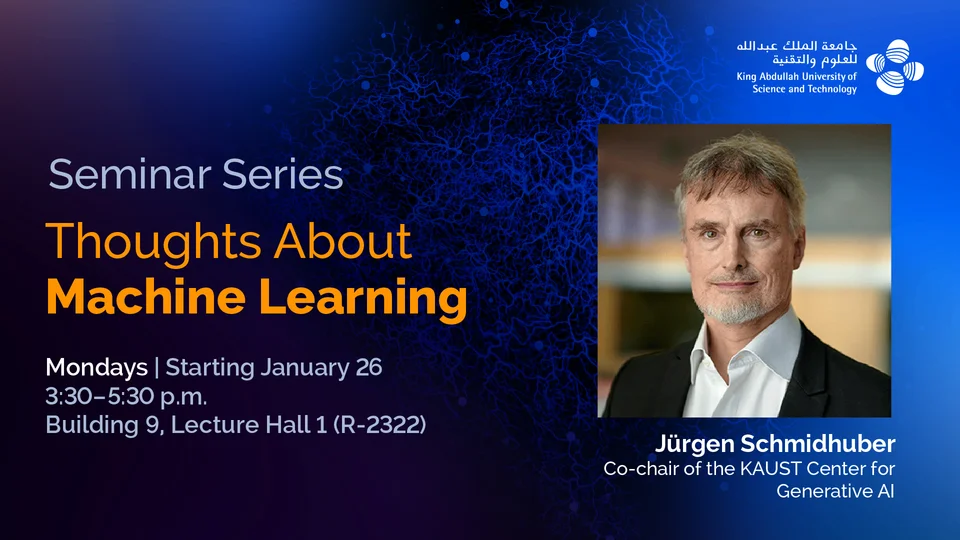
Thoughts About Machine Learning Jürgen Schmidhuber, Professor, Computer Science Jan 26, 15:30 - 17:30 B9, Lecture Hall 1, R-2322 AI machine learning deep learning A weekly seminar series from January 26 to April 20, 2026, exploring advanced AI concepts beyond the scope of standard deep learning courses.
Shedding New Light on the Past: Applications of Multi-Light Image Collections in Cultural Heritage Ruggero Pintus, Senior Researcher, Center for Advanced Studies, Research and Development in Sardinia (CRS4) Jan 26, 12:00 - 13:00 B9 L2 R2325 interactive visualization image processing data acquisition This talk provides an overview of developing advanced tools for the digitization and exploration of Cultural Heritage assets, with a deep dive into Multi-Light Image Collections (MLICs) at Visual and Data Intensive Computing group at CRS4 (Italy).
KAUST Research Conference on Mathematical and Data Sciences Jan 26 - 28, All day KAUST Campus data science scientific computing Computer science Theory and applications of data science.
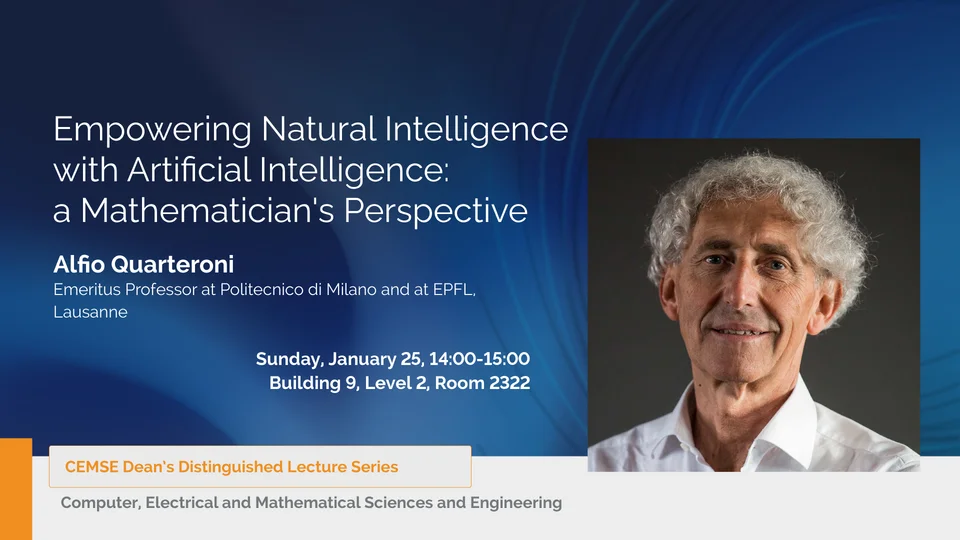
Empowering Natural Intelligence with Artificial Intelligence: a Mathematician's Perspective Alfio Quarteroni, Emeritus Professor, Politecnico di Milano and EPFL Jan 25, 14:00 - 15:00 B9, L2, R2322 Computational mathematics numerical methods Scientific Machine Learning scientific computing applied mathematics A Dean’s Distinguished Lecture on natural intelligence, artificial intelligence and scientific machine learning.
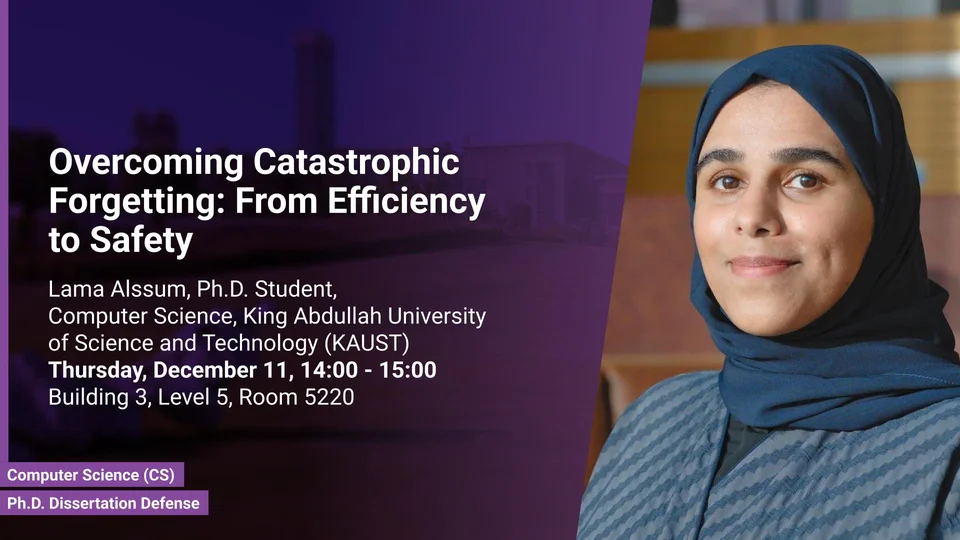
Overcoming Catastrophic Forgetting: From Efficiency to Safety Lama Alssum, Ph.D. Student, Computer Science Dec 11, 14:00 - 15:00 B3 L5 R5220 AI machine learning Computer Vision This thesis addresses the challenge of catastrophic forgetting in AI by developing novel continual learning methods that enhance memory efficiency in video analysis and preserve safety alignment in large language models, ensuring reliable adaptation in both resource-constrained and safety-critical applications.
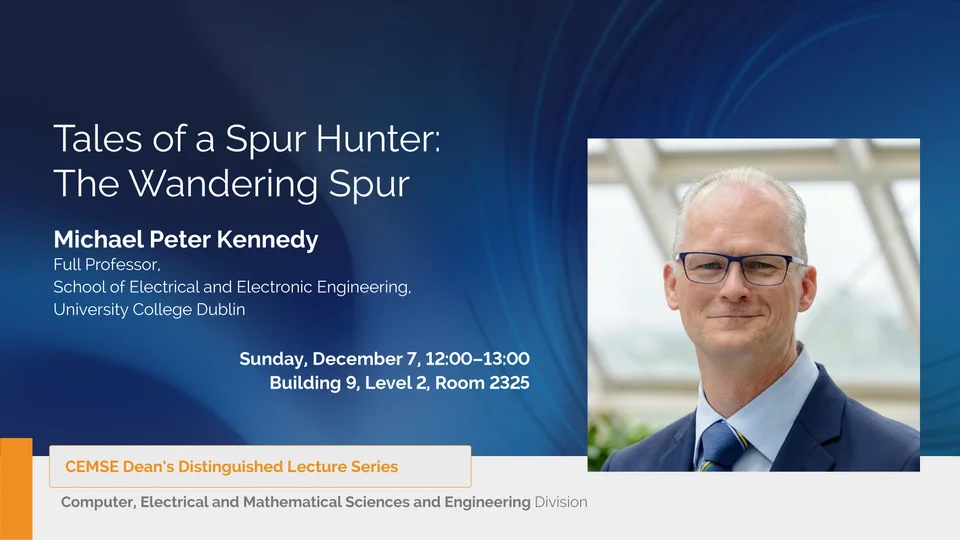
Tales of a Spur Hunter: The Wandering Spur Michael Peter Kennedy, Full Professor, School of Electrical and Electronic Engineering, University College Dublin Dec 7, 12:00 - 13:00 B9 L2 R2325 Prof. Michael Peter Kennedy presents the decade-long journey to diagnose and fix 'wandering spurs' in frequency synthesizers.
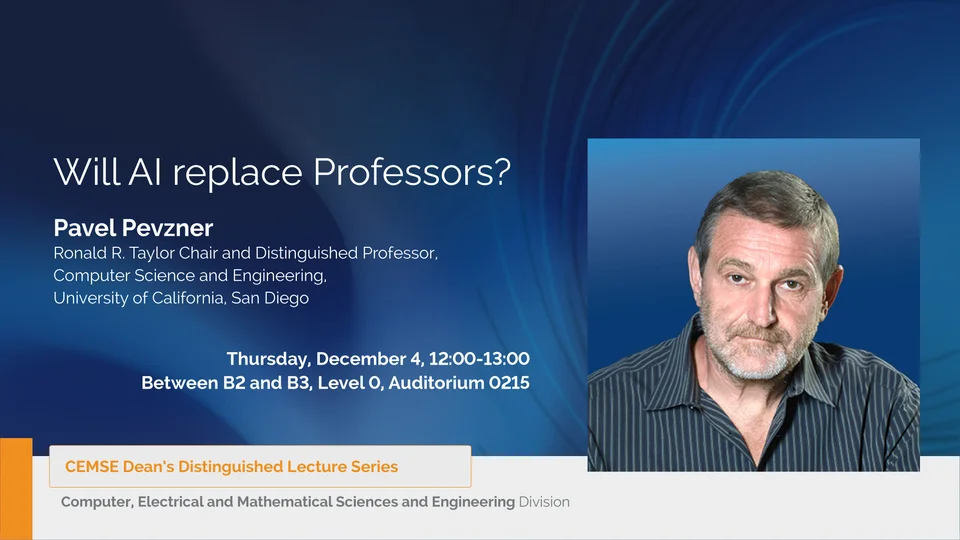
Will AI Replace Professors? Pavel Pevzner, Ronald R. Taylor Chair and Distinguished Professor, Computer Science and Engineering, University of California, San Diego Dec 4, 12:00 - 13:00 B2/B3 L0 A0215 This talk explores Massive Adaptive Interactive Texts (MAITs) as a pioneering AI technology that aims to replace the one-size-fits-all lecture model with a responsive and scalable system for individualized instruction.
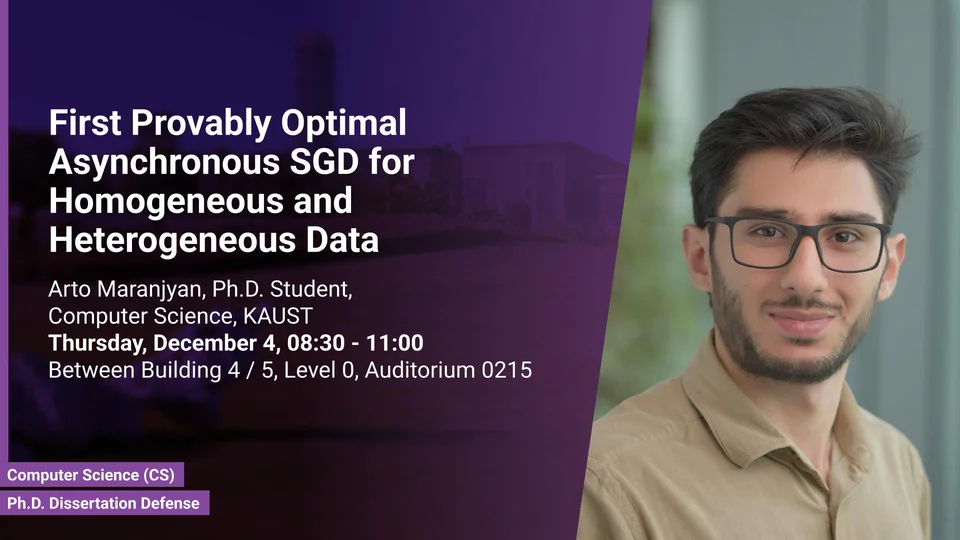
First Provably Optimal Asynchronous SGD for Homogeneous and Heterogeneous Data Arto Maranjyan, Ph.D. Student, Computer Science Dec 4, 08:30 - 11:00 B4/5 L0 A0215 machine learning optimization asynchronous algorithms Training This thesis introduces a novel framework for asynchronous first-order stochastic optimization centered on heterogeneous worker speeds that remain fast, stable, and even provably optimal.
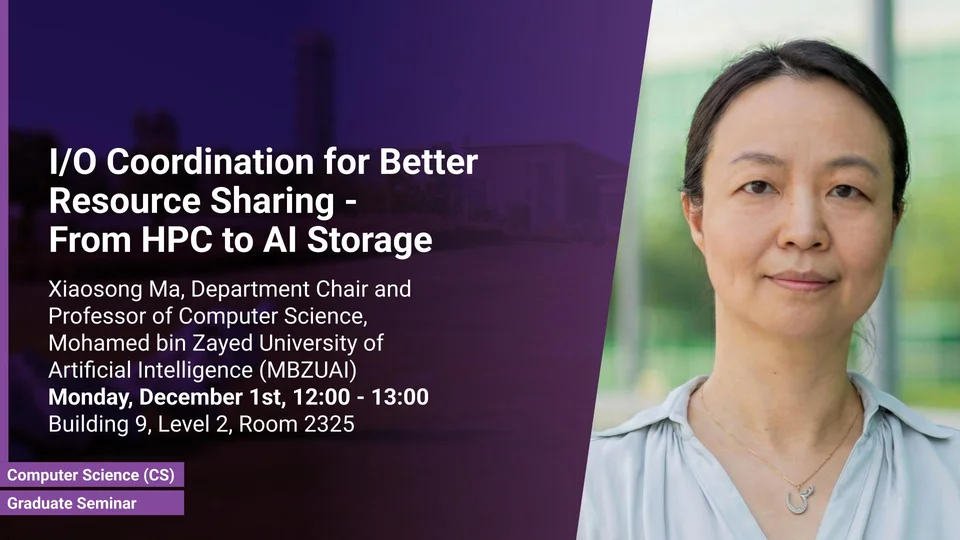
I/O Coordination for Better Resource Sharing - From HPC to AI Storage Xiaosong Ma, Department Chair and Professor of Computer Science, Mohamed bin Zayed University of Artificial Intelligence (MBZUAI) Dec 1, 12:00 - 13:00 B9, Level 2, Room 2325 ai storage In this talk, through a personal journey of parallel and distributed storage systems, I hope to share observations and lessons from these past projects.
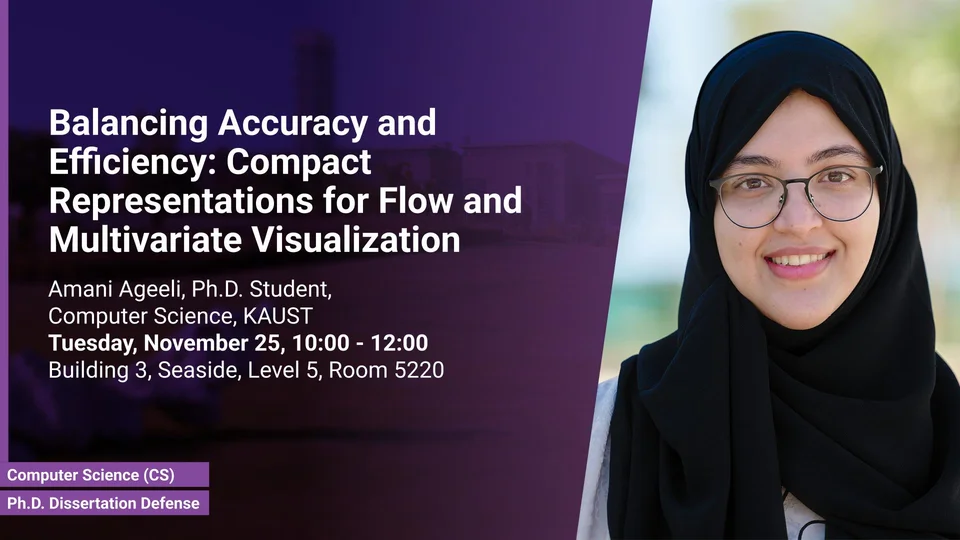
Balancing Accuracy and Efficiency: Compact Representations for Flow and Multivariate Visualization Amani Ageeli, Ph.D. Student, Computer Science Nov 25, 10:00 - 12:00 B3 L5 R5220 Scientific Visualization real-time rendering computer graphics interactive visualization large datasets multivariate functional data This thesis addresses the challenge of interactively visualizing massive scientific datasets by introducing novel frameworks that strategically balance accuracy and efficiency for scalable multivariate filtering, objective time-dependent flow analysis, and hybrid, complexity-guided flow reconstruction.
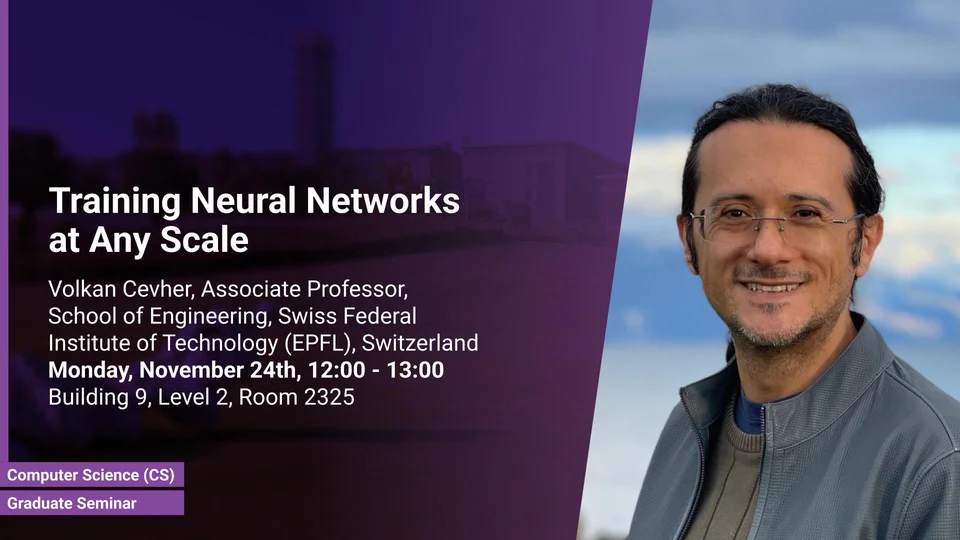
Training Neural Networks at Any Scale Volkan Cevher, Associate Professor, School of Engineering, Swiss Federal Institute of Technology (EPFL), Switzerland Nov 24, 12:00 - 13:00 B9 L2 R2325 machine learning Numerical simulation and analysis Reinforcement Learning deep learning optimization The talk explores a key mathematical ingredient of scaling in tandem with scaling theory: the numerical solution algorithms commonly employed in deep learning, spanning domains from vision to language models.
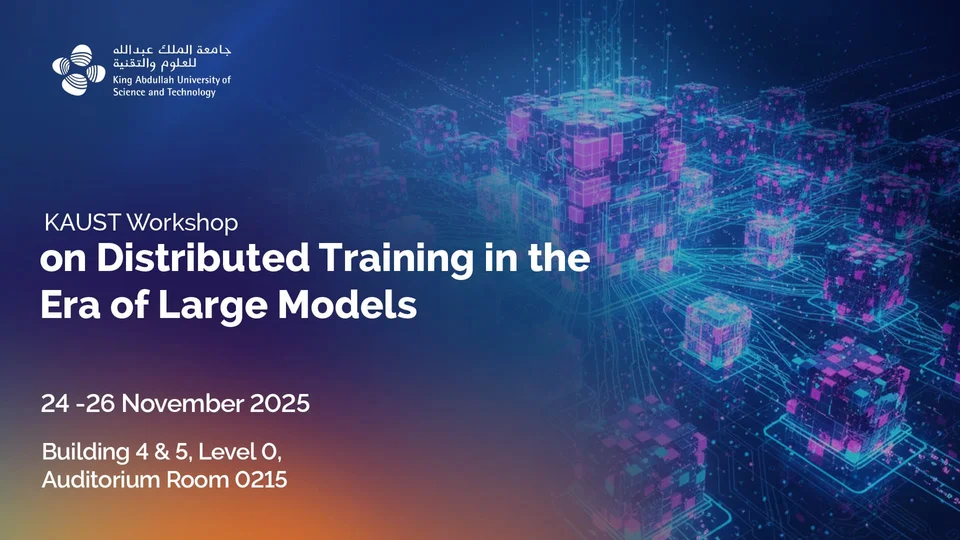
KAUST Workshop on Distributed Training in the Era of Large Models Nov 24 - 26, All day Auditorium between B4 & 5, L0, R0215 machine learning Distributed algorithms generative models ML Join leading researchers and innovators to explore how distributed training is reshaping the next generation of large-scale AI models.
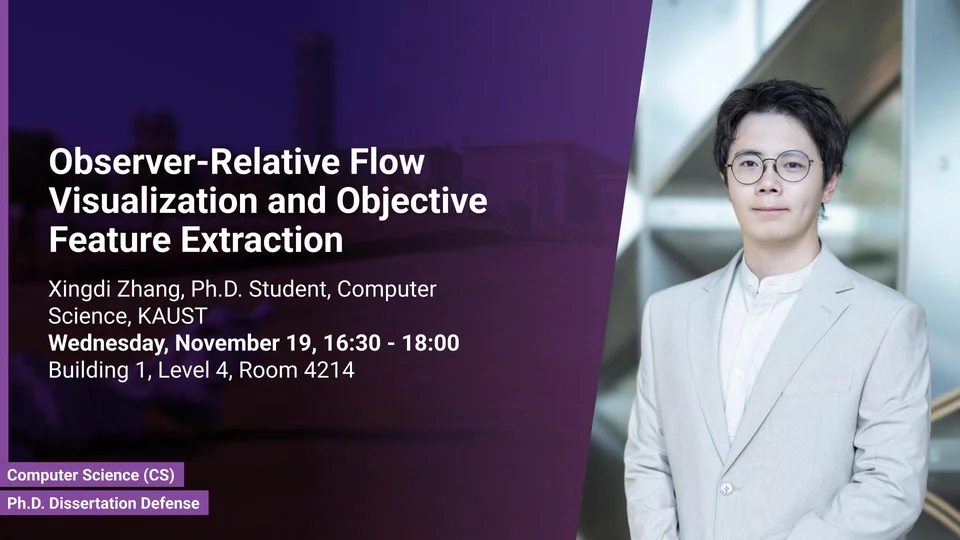
Observer-Relative Flow Visualization and Objective Feature Extraction Xingdi Zhang, Postdoctoral Research Fellow, Computer Science Nov 19, 16:30 - 18:00 B1 L4 R4214 visual computing scientific computing deep learning This dissertation develops an integrated toolkit of novel visualization and feature extraction methods, grounded in a Riemannian geometry framework, to enable an objective, observer-relative, and physically consistent analysis of complex unsteady flows.
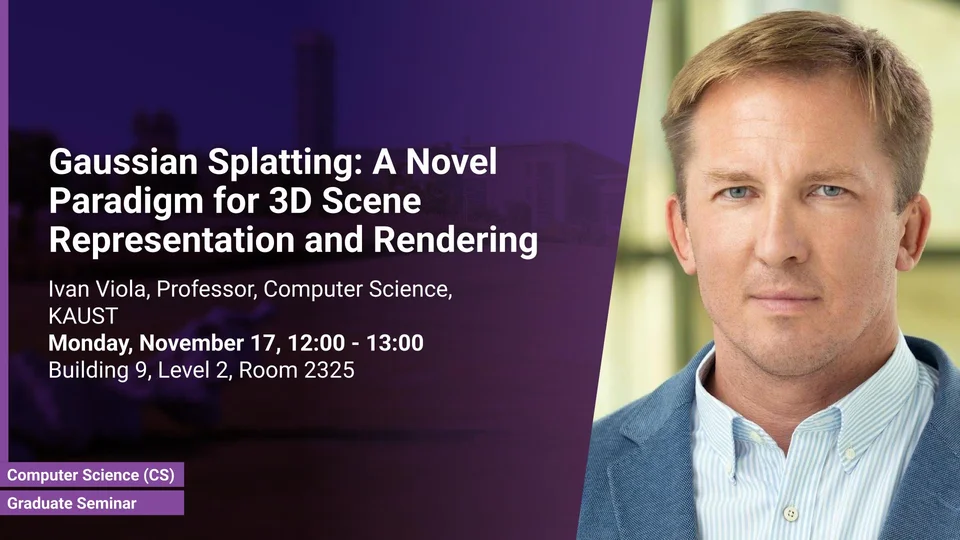
Gaussian Splatting: A Novel Paradigm for 3D Scene Representation and Rendering Ivan Viola, Professor, Computer Science Nov 17, 12:00 - 13:00 B9 L2 R2325 This talk will provide a comprehensive overview of 3D Gaussian Splatting, a novel and powerful technique for 3D scene representation and rendering.
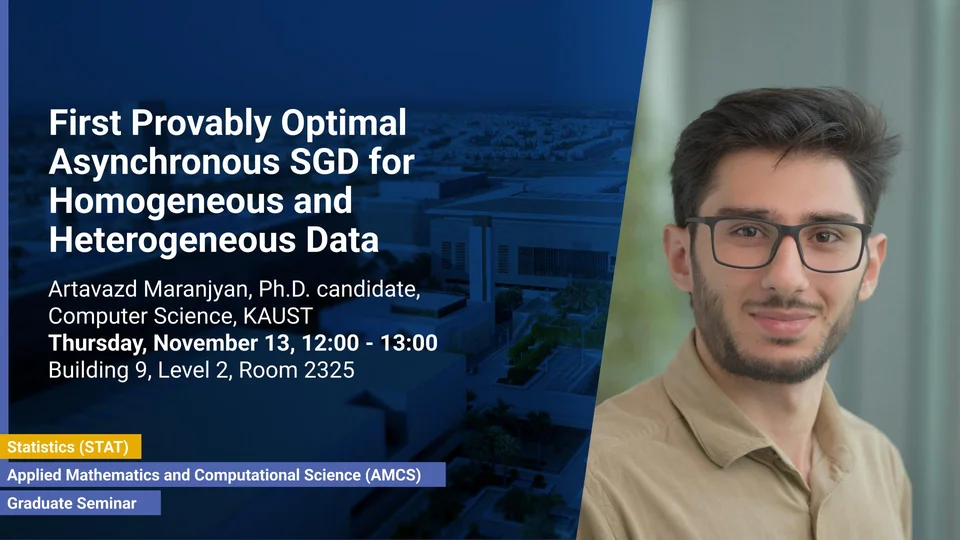
First Provably Optimal Asynchronous SGD for Homogeneous and Heterogeneous Data Arto Maranjyan, Ph.D. Student, Computer Science Nov 13, 12:00 - 13:00 B9 L2 R2325 machine learning optimization asynchronous algorithms Training This talk will discuss how to design asynchronous optimization methods that remain fast, stable, and even provably optimal.